KS3 Science
Years 7–9 biology, chemistry & physics
Jump into a topic All 6 topics ↓
100% free · no sign-up needed · works on any device
Where can I practise KS3 Science for free?
PassNova offers free Key Stage 3 (Years 7–9) Science practice questions across Biology (cells and body systems, nutrition, reproduction, ecosystems, genetics), Chemistry (particles and atoms, chemical reactions, the periodic table, materials, Earth science) and Physics (energy and forces, waves, electricity, matter, space), each with a clear explanation. Written from the DfE's official KS3 programme of study — 100% free, no sign-up. Updated for 2026.
Question bank last updated
Build a quiz your way
Pick the topics, choose how many questions, and run it with explanations as you go or as a timed test scored at the end. It is on the practice menu.
Start practising →A complete map of the KS3 Science syllabus
Tap a topic to start practising it — every question comes with a clear explanation. Or work the whole bank in study mode.
Where it leads
KS3 builds the foundation for GCSE science, a stated requirement for teaching, nursing and pharmacy routes.
Building towards GCSE science
Standard employer requirementGCSE science at grade 4 or above is required for primary teaching, nursing and pharmacy routes.
National Careers ServiceNursing degree entry (future)
Standard employer requirementNursing degrees need 4 or 5 GCSEs at grades 9 to 4 including maths, English and science.
National Careers ServiceRequirements are checked against the National Careers Service, the relevant regulator or the awarding body — follow each source for the current rules.
How you'll get exam-ready
Built to get you exam-ready
Instant, worked explanations
Every question — right or wrong — comes with a clear explanation, so you learn the why, not just the what.
Timed practice tests
Sit timed 25-question tests against an indicative pass mark, so working to the clock feels familiar.
A live readiness scoreFree + Premium
See how ready you are at a glance — Premium turns it into a predicted result.
Nova, your AI tutorPremium
Stuck on a question? Nova explains it step by step, in plain English, the moment you ask.
No paywall. No taster limit. No sign-up.
Every question and every practice test for KS3 Science is free to practise. A free account just saves your progress — Premium is entirely optional.
Start practising free →- ✓All 170 questions across every topic
- ✓All 6 timed practice tests
- ✓A worked explanation on every question
- ✓A live readiness score
- ✓No sign-up, no paywall, no limits
KS3 Science explained
Key Stage 3 (KS3) Science covers Years 7, 8 and 9 in England — the three years before GCSE study begins. It's set out in the DfE's statutory national curriculum and is assessed by individual schools, not by a national exam.
The three sciences
- Biology: cells and organisation, skeletal and muscular systems, nutrition and digestion, gas exchange, reproduction, photosynthesis and respiration, ecosystems, genetics and evolution.
- Chemistry: the particulate nature of matter, atoms/elements/compounds, pure and impure substances, chemical reactions, the periodic table, materials, and Earth and atmosphere.
- Physics: energy costs and transfers, forces and motion, pressure, waves and light, electricity and magnetism, the particle model of matter, and space physics.
How it fits with GCSE
KS3 builds the foundations GCSE Science depends on. It deliberately stops short of GCSE-only content — moles and stoichiometry, detailed electrolysis, circuit-law calculations and hormone-level biology all wait until Key Stage 4.
How to revise
Work through PassNova's six topics — two per science — in study mode, then use timed mocks to check recall across all three subjects. A solid KS3 foundation makes GCSE Science, Combined or Triple, much more manageable.
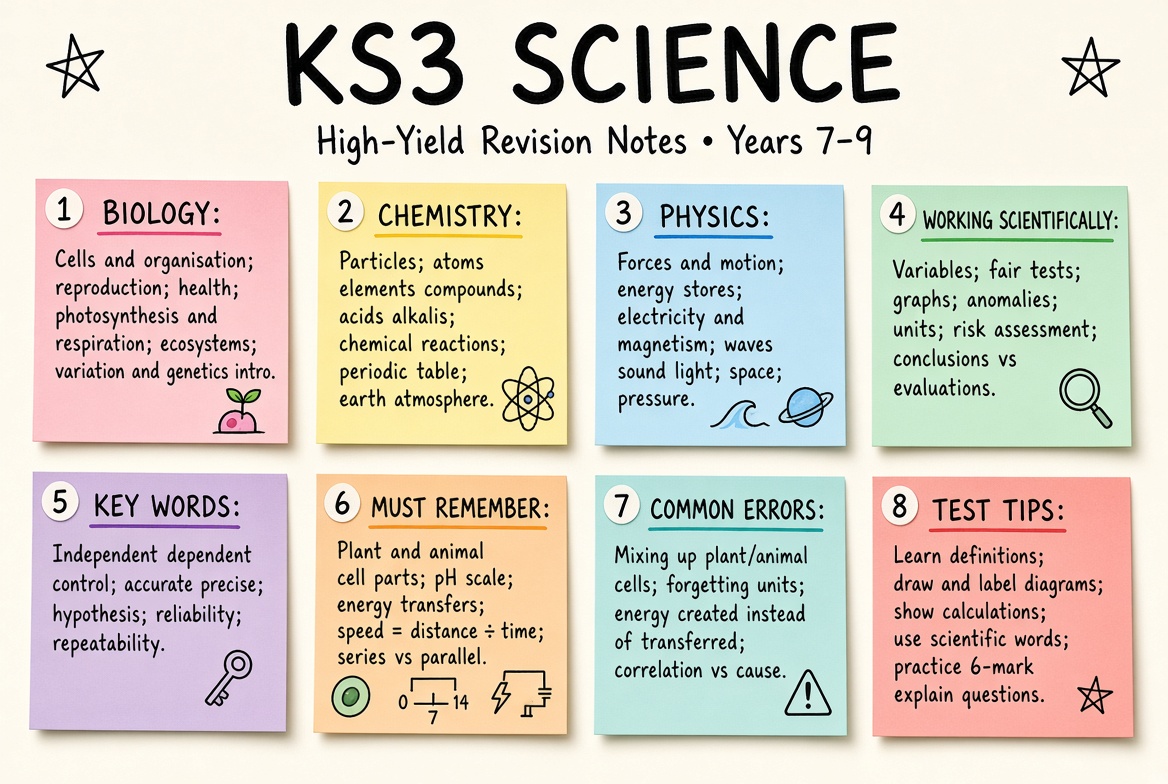
KS3 Science on one page
A quick-glance summary of the high-yield points — free to save, print or share.
Free official practice & past papers
Straight from the exam body — official free practice and past papers for KS3 Science. PassNova's own questions are original exam-style practice; these are the awarding body's materials.
External official sites — free where shown; some may require a free account. Links open in a new tab.
Where this leads
ℹ️ KS3 is assessed by your school — there is no exam to book. This is free practice to stay on track for GCSE.
External official sites — fees and booking are handled by the provider, not PassNova.
PassNova is independent and not affiliated with or endorsed by the exam's awarding body.
KS3 Science: your questions answered
What does the KS3 Science curriculum cover?
All three sciences set out in the DfE's national curriculum: Biology (cells, body systems, reproduction, ecosystems, genetics), Chemistry (particles, atoms, reactions, the periodic table, materials, Earth science), and Physics (energy, forces, waves, electricity, matter, space).
Is there an exam for KS3 Science?
No — Key Stage 3 is assessed by your own school through internal tests and teacher assessment rather than a national exam. Practising builds the foundation for GCSE Science, which starts properly at Key Stage 4.
How is KS3 Science different from GCSE Science?
KS3 covers the same three sciences but at an earlier, simpler depth — for example, KS3 chemistry doesn't cover moles or detailed electrolysis, and KS3 physics circuits are qualitative rather than calculation-heavy. These deeper topics wait until GCSE.
Is PassNova's KS3 Science practice really free?
Yes — all Key Stage 3, GCSE, Functional Skills and ESOL practice on PassNova is completely free, with no sign-up needed to start. A free account is optional and just saves your progress.
Where is KS3 Science required or accepted?
KS3 builds the foundation for GCSE science, a stated requirement for teaching, nursing and pharmacy routes. Building towards GCSE science: GCSE science at grade 4 or above is required for primary teaching, nursing and pharmacy routes. Nursing degree entry (future): Nursing degrees need 4 or 5 GCSEs at grades 9 to 4 including maths, English and science.
Is PassNova's KS3 Science practice free?
Yes — KS3 Science practice on PassNova is 100% free. There's no paywall and no sign-up needed to start. A free account is optional and only saves your progress and badges.
Do I need an account or have to pay?
No. You can start practising KS3 Science instantly with no account, no email and no card. 104 courses are fully free; every Premium question bank has a free 15-question taster.
How many KS3 Science practice questions does PassNova have?
PassNova has 170 exam-style KS3 Science questions and 6 timed 25-question practice tests, each with a clear explanation, plus topic-by-topic study mode.
Is the KS3 Science practice up to date for 2026?
Key Stage 3 (Years 7–9) Science is set by the DfE's statutory "Science programmes of study: key stage 3" (National curriculum in England, September 2013, ref DFE-00185-2013) — the curriculum all local-authority-maintained schools in England must teach. There is no external KS3 exam; schools assess pupils' progress internally, usually building towards GCSE. This course covers Biology, Chemistry and Physics at KS3 depth, distinct from GCSE content (no moles/stoichiometry, no reactivity-series electrolysis, no circuit-law calculations, no hormone-level biology, which are GCSE topics). Checked against the DfE programme of study in September 2026.
Ready to pass your KS3 Science?
No paywall, no sign-up. Jump straight into KS3 Science practice and learn at your own pace.