GCSE Combined Science
AQA / Edexcel / OCR — Biology, Chemistry & Physics
Jump into a topic All 6 topics ↓
100% free · no sign-up needed · works on any device
Where can I practise GCSE Combined Science for free?
PassNova offers free GCSE Combined Science practice questions across Biology (cell biology, organisation and health, coordination, photosynthesis, ecosystems, genetics and evolution), Chemistry (atomic structure and bonding, chemical changes, energy, rates of reaction, analysis, industry and Earth science) and Physics (energy, forces and motion, waves, electricity, magnetism, particle model and atomic structure), each with a clear explanation. Written from the DfE's official Combined Science subject content, which every exam board must follow — 100% free, no sign-up. Updated for 2026.
Question bank last updated
Build a quiz your way
Pick the topics, choose how many questions, and run it with explanations as you go or as a timed test scored at the end. It is on the practice menu.
Start practising →A complete map of the GCSE Combined Science syllabus
Tap a topic to start practising it — every question comes with a clear explanation. Or work the whole bank in study mode.
Where a science GCSE is required
A science GCSE at grade 4 or above is a stated requirement for teaching, nursing and pharmacy routes.
Primary teacher training
Standard employer requirementGCSE science at grade 9 to 4 is required for primary school teaching.
National Careers ServiceNursing degree entry
Standard employer requirement4 or 5 GCSEs at grades 9 to 4 including English, maths and science.
National Careers ServicePharmacy technician
Standard employer requirement4 GCSEs at grades 9 to 4 including English, maths and science for the work-based route.
National Careers ServiceMedicine and dentistry
Standard employer requirementAt least 5 GCSEs at grades 9 to 7 including English, maths and sciences.
National Careers ServiceRequirements are checked against the National Careers Service, the relevant regulator or the awarding body — follow each source for the current rules.
How you'll get exam-ready
Built to get you exam-ready
Instant, worked explanations
Every question — right or wrong — comes with a clear explanation, so you learn the why, not just the what.
Timed practice tests
Sit timed 25-question tests against an indicative pass mark, so working to the clock feels familiar.
A live readiness scoreFree + Premium
See how ready you are at a glance — Premium turns it into a predicted result.
Nova, your AI tutorPremium
Stuck on a question? Nova explains it step by step, in plain English, the moment you ask.
No paywall. No taster limit. No sign-up. (Premium adds timed exam papers of 40 questions in 60 minutes)
Every question and every practice test for GCSE Combined Science is free to practise. A free account just saves your progress — Premium is entirely optional.
Start practising free →- ✓All 274 questions across every topic
- ✓All 6 timed practice tests
- ✓A worked explanation on every question
- ✓A live readiness score
- ✓No sign-up, no paywall, no limits
Exams coming up? Find out where your marks are going.
Practice stays free. Premium adds the papers and feedback that move your grade.
- ✓2 timed exam-style papers with exclusive questions and an indicative grade
- ✓Your readiness score, topic by topic, so you know which topics are costing you marks
- ✓Nova explains the science behind any answer you get wrong, step by step
- ✓Smart practice and review that bring back what you got wrong
- ✓A week-by-week revision plan to your exam date
Then £4.99/month or £39.99/year · cancel anytime · secure checkout with Stripe
Timed practice tests
6 timed practice tests
Sit a timed 25-question practice test (25 minutes), then review every answer with its explanation.
Free to practiseExam Papers
A timed 40-question exam-style set across biology, chemistry and physics, with exclusive questions on equations, required practicals and working scientifically, and an indicative double-award grade band. The real GCSE is six 70-minute written papers, so treat the band as a guide rather than a prediction.
The grade boundaries are PassNova’s indicative estimate, not an official figure.
GCSE Combined Science explained
GCSE Combined Science covers Biology, Chemistry and Physics in one qualification, resulting in two GCSE grades. It's set out in the DfE's Combined Science subject content document, which every exam board must build against.
The three sciences
- Biology: cell biology, transport systems, health and disease, coordination and control, photosynthesis, ecosystems, and inheritance/variation/evolution.
- Chemistry: atomic structure and the periodic table, structure and bonding, chemical changes, energy changes, rates of reaction, chemical analysis, industry, and Earth/atmospheric science.
- Physics: energy, forces and motion, waves, light and electromagnetic radiation, electricity, magnetism, the particle model of matter, and atomic structure.
How it's assessed
Combined Science counts as two GCSEs, with content split at least 30% each between the three sciences. The exam boards each publish their own detailed specification, but the DfE's subject content document sets the common scope every board must cover.
How to revise
Work through PassNova's six topics — two per science — in study mode, then use timed mocks to check recall across all three subjects together, since the real exam papers mix topics within each science.
Guides for this exam
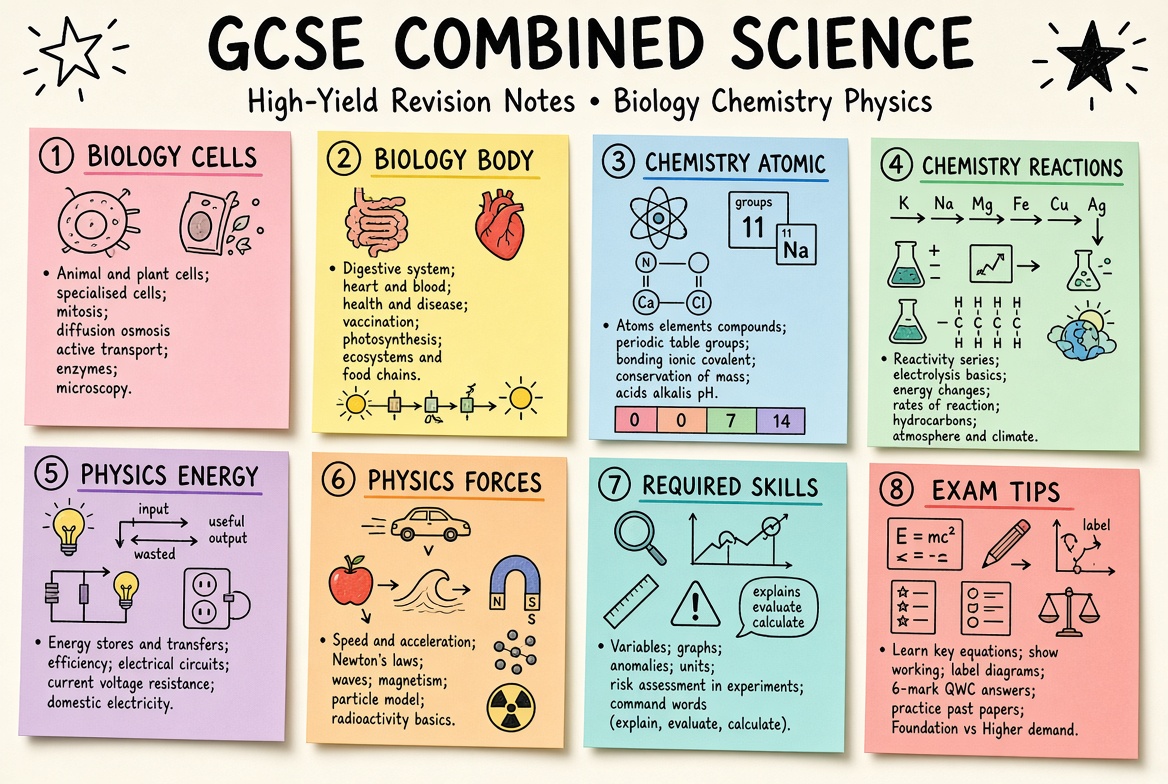
GCSE Combined Science on one page
A quick-glance summary of the high-yield points — free to save, print or share.
Free official practice & past papers
Straight from the exam body — official free practice and past papers for GCSE Combined Science. PassNova's own questions are original exam-style practice; these are the awarding body's materials.
External official sites — free where shown; some may require a free account. Links open in a new tab.
Where the real exam comes from
PassNova is independent practice — you sit the official GCSE Combined Science with the body that runs it.
ℹ️ Sit your GCSE at a school or as a private candidate at a registered exam centre, through an exam board below.
External official sites — fees and booking are handled by the provider, not PassNova.
PassNova is independent and not affiliated with or endorsed by the exam's awarding body.
GCSE Combined Science: your questions answered
What does GCSE Combined Science cover?
All three sciences — Biology, Chemistry and Physics — each making up at least 30% of the content, set out in the DfE's Combined Science subject content document. It results in two GCSE grades rather than one.
Do all exam boards test the same content?
The DfE sets a common subject-content framework every board — AQA, Pearson Edexcel, OCR — must build against, so the core topics are the same nationally. Individual boards (e.g. AQA Trilogy, OCR Gateway or 21st Century) may vary question style and naming.
What's the difference between Combined Science and Triple Science?
Combined Science covers the same three subjects but in less depth than Triple (separate) Science, and results in two GCSEs instead of three. Combined Science remains a common and well-respected route into further science study.
Is PassNova's Combined Science practice really free?
Yes — all GCSE, Functional Skills, Key Stage 3 and ESOL practice on PassNova is completely free, with no sign-up needed to start. A free account is optional and just saves your progress.
Where is GCSE Combined Science required or accepted?
A science GCSE at grade 4 or above is a stated requirement for teaching, nursing and pharmacy routes. Primary teacher training: GCSE science at grade 9 to 4 is required for primary school teaching. Nursing degree entry: 4 or 5 GCSEs at grades 9 to 4 including English, maths and science. Pharmacy technician: 4 GCSEs at grades 9 to 4 including English, maths and science for the work-based route. Medicine and dentistry: At least 5 GCSEs at grades 9 to 7 including English, maths and sciences.
Is PassNova's GCSE Combined Science practice free?
Yes — GCSE Combined Science practice on PassNova is 100% free. There's no paywall and no sign-up needed to start (Premium adds timed exam papers of 40 questions in 60 minutes). A free account is optional and only saves your progress and badges.
Do I need an account or have to pay?
No. You can start practising GCSE Combined Science instantly with no account, no email and no card. 104 courses are fully free; every Premium question bank has a free 15-question taster.
How many GCSE Combined Science practice questions does PassNova have?
PassNova has 274 exam-style GCSE Combined Science questions and 6 timed 25-question practice tests, each with a clear explanation, plus topic-by-topic study mode.
Is the GCSE Combined Science practice up to date for 2026?
GCSE Combined Science is set by the DfE's "Combined science: GCSE subject content" (June 2015, Crown copyright) — the common framework every exam board (AQA Trilogy, Pearson Edexcel Combined Science, OCR Gateway/21st Century) must build its specification against, so the core topics are examined nationally regardless of board. Combined Science counts as two GCSEs and must be at least 30% Biology, 30% Chemistry and 30% Physics. Some content is Higher-tier only (marked in the DfE document); this course mainly covers content required at both tiers, with a small amount of Higher-only material included at harder difficulty. Checked against the DfE subject content in September 2026.
Ready to pass your GCSE Combined Science?
No paywall, no sign-up. Jump straight into GCSE Combined Science practice and learn at your own pace.