Asbestos Awareness
Category A awareness — CAR 2012
Jump into a topic All 9 topics ↓
- What Asbestos Is & Where It’s Found14 questions
- Health Risks & Diseases14 questions
- The Law & Duty to Manage14 questions
- Recognising Asbestos Materials14 questions
- Types of Asbestos Work13 questions
- If You Find or Disturb Asbestos13 questions
- Controls, PPE & Decontamination13 questions
- Surveys, Registers & Records12 questions
- Training & Responsibilities12 questions
100% free · no sign-up needed · works on any device
Where can I practise Asbestos Awareness for free?
PassNova offers free asbestos awareness practice — exam-style questions covering how to recognise asbestos-containing materials, the health risks, the duties under the Control of Asbestos Regulations 2012, and what to do if you find or disturb asbestos. Asbestos awareness (Category A) training teaches you to avoid disturbing asbestos and report it; it does not qualify you to work on it. 100% free, no sign-up.
Question bank last updated
Build a quiz your way
Pick the topics, choose how many questions, and run it with explanations as you go or as a timed test scored at the end. It is on the practice menu.
Start practising →A complete map of the Asbestos Awareness syllabus
Tap a topic to start practising it — every question comes with a clear explanation. Or work the whole bank in study mode.
- What Asbestos Is & Where It’s Found14 questions
- Health Risks & Diseases14 questions
- The Law & Duty to Manage14 questions
- Recognising Asbestos Materials14 questions
- Types of Asbestos Work13 questions
- If You Find or Disturb Asbestos13 questions
- Controls, PPE & Decontamination13 questions
- Surveys, Registers & Records12 questions
- Training & Responsibilities12 questions
Jobs and roles this helps you get
HSE requires asbestos awareness training for anyone whose work could disturb asbestos.
Electrician
Required by law or a regulatorHSE names this trade as needing asbestos awareness training (Control of Asbestos Regulations 2012, reg 10).
gov.ukPlumber / heating engineer
Required by law or a regulatorNamed by HSE among the trades whose work could disturb asbestos.
gov.ukJoiner / carpenter
Required by law or a regulatorNamed by HSE among the trades whose work could disturb asbestos.
gov.ukPainter and decorator / plasterer
Required by law or a regulatorNamed by HSE among the trades whose work could disturb asbestos.
gov.ukGeneral maintenance worker
Required by law or a regulatorNamed by HSE among the roles whose work could disturb asbestos.
gov.ukRoofer, demolition or construction worker
Required by law or a regulatorNamed by HSE among the trades whose work could disturb asbestos.
gov.ukRequirements are checked against the National Careers Service, the relevant regulator or the awarding body — follow each source for the current rules.
How you'll get exam-ready
Built to get you exam-ready
Instant, worked explanations
Every question — right or wrong — comes with a clear explanation, so you learn the why, not just the what.
Timed practice tests
Sit timed 25-question tests against an indicative pass mark, so working to the clock feels familiar.
A live readiness scoreFree + Premium
See how ready you are at a glance — Premium turns it into a predicted result.
Nova, your AI tutorPremium
Stuck on a question? Nova explains it step by step, in plain English, the moment you ask.
No paywall. No taster limit. No sign-up.
Every question and every practice test for Asbestos Awareness is free to practise. A free account just saves your progress — Premium is entirely optional.
Start practising free →- ✓All 119 questions across every topic
- ✓All 4 timed practice tests
- ✓A worked explanation on every question
- ✓A live readiness score
- ✓No sign-up, no paywall, no limits
Asbestos awareness explained
Asbestos awareness — often called Category A training — is for anyone whose work could disturb asbestos without meaning to: electricians, plumbers, joiners, heating engineers, shopfitters and general maintenance staff. It is required under regulation 10 of the Control of Asbestos Regulations 2012.
What awareness training is, and what it is not
Awareness training teaches you to recognise asbestos-containing materials, avoid disturbing them, and report what you find. It explicitly does not qualify you to work on asbestos, take samples or remove anything. Work with asbestos needs further non-licensed training, and the highest-risk materials — sprayed coatings, lagging and most asbestos insulating board — can only be handled by an HSE-licensed contractor.
Why it still matters
Asbestos was banned in stages: blue and brown in 1985, white on 24 November 1999. The ban stopped new use but removed nothing already installed, so any building built or refurbished before 2000 may contain it. Asbestos remains the largest single cause of work-related deaths in Great Britain, at roughly 5,000 deaths a year, and the diseases it causes can take 15 to 60 years to appear.
The duty to manage
Under regulation 4, whoever is responsible for the maintenance and repair of non-domestic premises must find out whether asbestos is present, record its location and condition in an asbestos register, assess the risk and keep a management plan. Crucially, the duty is to manage the risk, not to strip the building: material in good condition that will not be disturbed is usually safer left in place.
What to do if you find it
Stop work, leave it undisturbed, keep others out and report it. Never sweep debris or use an ordinary vacuum — both put fibres back into the air. And always check the asbestos register before you start drilling, cutting or lifting in an older building.
How to revise
The assessment rewards knowing what to do rather than memorising legislation. Work each topic in study mode, then sit timed mocks. PassNova’s 119 asbestos awareness questions explain every answer — 100% free, no sign-up. It is revision practice, not an accredited Category A course.
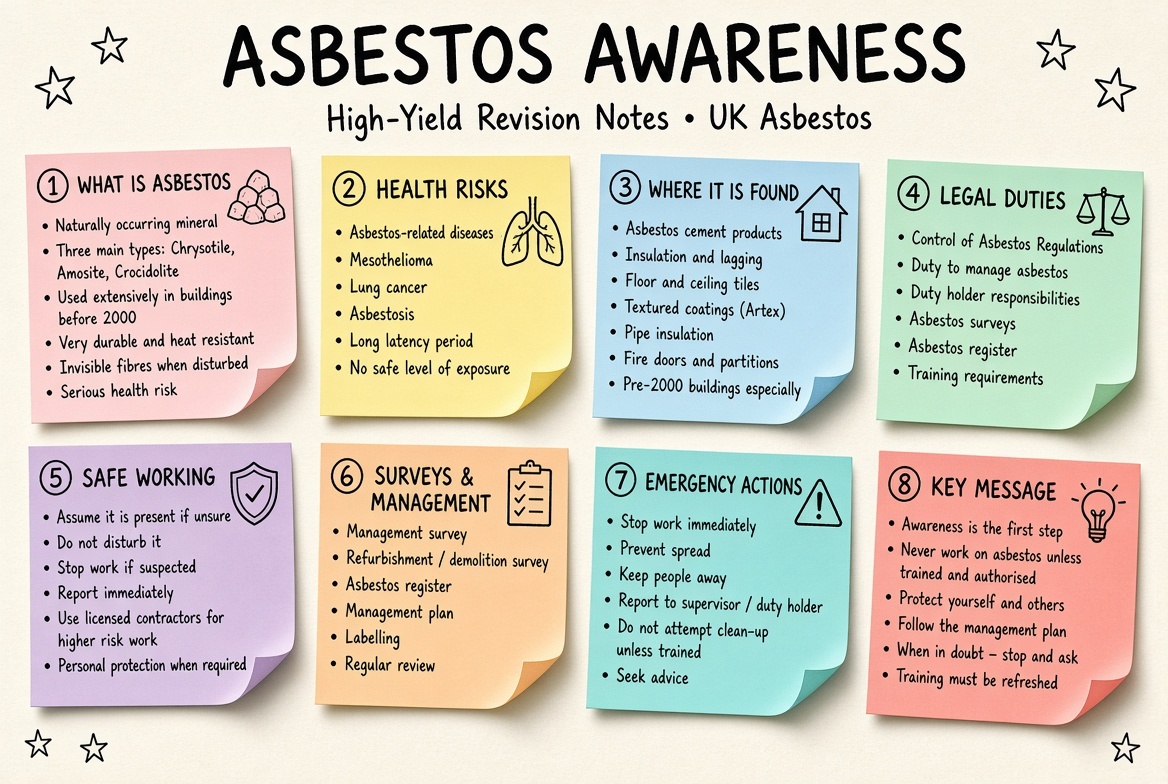
Asbestos Awareness on one page
A quick-glance summary of the high-yield points — free to save, print or share.
Where the real exam comes from
PassNova is independent practice — you sit the official Asbestos Awareness with the body that runs it.
ℹ️ Asbestos awareness training must be delivered by a competent provider (for example UKATA or IATP approved). PassNova is free revision, not an accredited course or a certificate.
External official sites — fees and booking are handled by the provider, not PassNova.
PassNova is independent and not affiliated with or endorsed by the exam's awarding body.
Asbestos Awareness: your questions answered
Does asbestos awareness training let me remove asbestos?
No. Asbestos awareness (Category A) training teaches you to recognise asbestos, avoid disturbing it and report it. Working on asbestos requires further non-licensed or licensed training, and the highest-risk work can only be done by an HSE-licensed contractor.
How often should asbestos awareness training be refreshed?
HSE expects training to be kept up to date, and annual refresher training is common industry practice. It should also be repeated whenever working practices, the law or the type of work changes.
Which buildings are likely to contain asbestos?
Any building built or refurbished before 2000. Blue and brown asbestos were banned in 1985 and white asbestos in November 1999, so anything from before that date should be presumed to contain asbestos until testing proves otherwise.
What should I do if I think I have disturbed asbestos?
Stop work immediately, leave the material alone, prevent others entering the area and report it to your supervisor or the duty holder. Do not sweep up the debris or use a normal vacuum cleaner — both make fibres airborne again.
What jobs can I do with Asbestos Awareness?
HSE requires asbestos awareness training for anyone whose work could disturb asbestos. Electrician: HSE names this trade as needing asbestos awareness training (Control of Asbestos Regulations 2012, reg 10). Plumber / heating engineer: Named by HSE among the trades whose work could disturb asbestos. Joiner / carpenter: Named by HSE among the trades whose work could disturb asbestos. Painter and decorator / plasterer: Named by HSE among the trades whose work could disturb asbestos. General maintenance worker: Named by HSE among the roles whose work could disturb asbestos. Roofer, demolition or construction worker: Named by HSE among the trades whose work could disturb asbestos.
Is PassNova's Asbestos Awareness practice free?
Yes — Asbestos Awareness practice on PassNova is 100% free. There's no paywall and no sign-up needed to start. A free account is optional and only saves your progress and badges.
Do I need an account or have to pay?
No. You can start practising Asbestos Awareness instantly with no account, no email and no card. 104 courses are fully free; every Premium question bank has a free 15-question taster.
How many Asbestos Awareness practice questions does PassNova have?
PassNova has 119 exam-style Asbestos Awareness questions and 4 timed 25-question practice tests, each with a clear explanation, plus topic-by-topic study mode.
Is the Asbestos Awareness practice up to date for 2026?
Checked against HSE in August 2026. The control limit is 0.1 fibres per cm³ of air averaged over four hours, with a short-term limit of 0.6 fibres per cm³ over ten minutes — and in May 2026 HSE confirmed its position that the control limit stays as it is, after considering whether to tighten it. The duty to manage asbestos in non-domestic premises is regulation 4 of the Control of Asbestos Regulations 2012; information, instruction and training is regulation 10. Blue and brown asbestos were banned in 1985 and white asbestos on 24 November 1999, so any building built or refurbished before 2000 may contain asbestos. Asbestos still causes around 5,000 deaths a year in Great Britain, including 2,146 mesothelioma deaths in 2024. This bank covers awareness only: recognising asbestos, avoiding disturbance and reporting it. It is revision, not an accredited Category A course, and it does not qualify anyone to work with asbestos.
Ready to pass your Asbestos Awareness?
No paywall, no sign-up. Jump straight into Asbestos Awareness practice and learn at your own pace.